The published result reproduces
The original coefficients can be recovered. The disagreement is about interpretation, not arithmetic.
 Open discussions
 DRINKING WATER · ARSENIC · RANDOMIZED EVIDENCE
An independent reanalysis of a drinking-water arsenic information trial in India—and a practical example of how reasonable modelling decisions can change the scientific story.
同一批数据,采用不同但都合理的分析方法,为什么会得出完全不同的健康结论?
This is not a journal publication or a final verdict on the original trial. It is a documented working argument. We are publishing it now so that readers can challenge the data decisions, statistical models, and wording before the paper is treated as finished.
这不是正式发表的论文,也不是对原研究的最终裁决。我们选择在结论仍可修改时公开,希望读者直接指出数据处理、模型选择和表述中的问题。
The original coefficients can be recovered. The disagreement is about interpretation, not arithmetic.
The apparent reduction in stomach problems emerges mainly after controlling for knowledge gained after the intervention.
The individual arm may have improved, but the adjusted concentration difference is imprecise and the group arm shows no clear reduction.
One observation at 1.0 mg/L drives the apparently extreme nonlinear result. Removing it changes the joint p-value to 0.14.
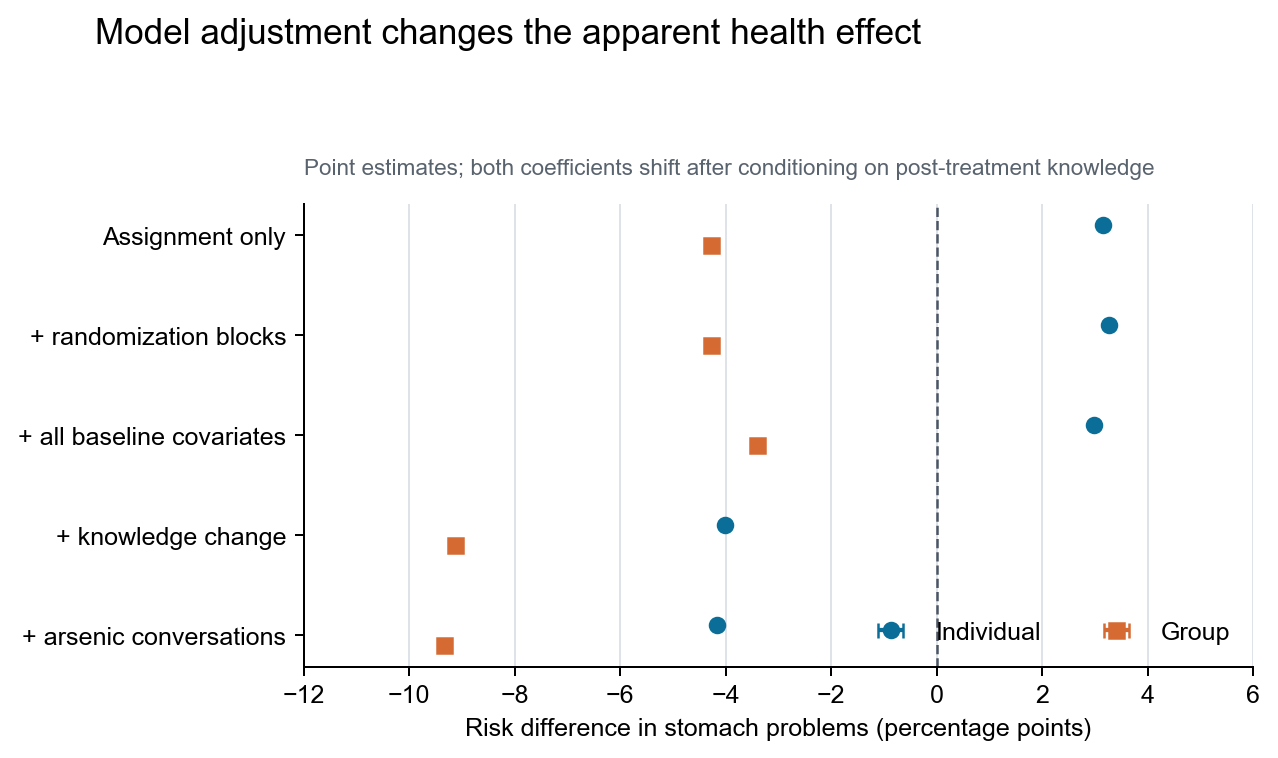
The group intervention appears to reduce stomach problems by 9.34 percentage points in the published model. In the randomized total-effect model, the estimate is 4.36 points and the confidence interval includes no effect.
The main shift occurs when the model controls for knowledge gained after the intervention. Because knowledge was one of the intended effects of the programme, that adjustment changes the question being answered.
Reproducible code tells us that the calculation can be repeated. It does not, by itself, tell us which interpretation is justified.
自然中文表达,包含完整方法、结果、讨论、图表和参考文献。
The complete English paper, including methods, numerical results, figures, limitations, and references.
Useful criticism is more valuable than general approval. We especially welcome comments on:
Comments appear with this article so that the evidence, criticism, and later revisions remain connected.
Loading comments…